UPCOMING EVENT
Calm Abiding & Special Insight – A 2-day Urban Meditation Retreat
Understanding ourselves, our world, and the nature of true well-being
Ticket price: $65 ($75 after March 1) plus a $20 text
Saturday March 21 (12:30-5:30) and Sunday March 22 (9:30-5:30)
Center Space
1918 Union Avenue, Chattanooga
- In person and online (in-person recommended if at all possible)
- Saturday, March 21 (12:30-5:30) and Sunday, March 22 (9:30-5:30)
- Center Space, St Andrews Center, 1918 Union Avenue, Chattanooga
- $65 before March 1, $75 thereafter (Scholarships available on request)
- We will follow the text How to Meditate by Lama Samten, which is a separate $20 purchase if you do not already own it
- Note that this is an urban retreat, with no lodging. Snacks and drinks will be provided, but plan to bring your lunch for Sunday’s mid-day meal
- Suggested prerequisite: Calm Abiding and Introduction to Lamrim classes, or several years of experience with Buddhist philosophy and concentration meditation
The Opportunity
Approximately 2600 years ago, the historical Buddha attained enlightenment, finding after a long search the way to end suffering and find true happiness. His great gift was to teach the path to this same happiness. During this workshop, we will give an overview of the two main kinds of meditation: concentration meditation, in which we learn to focus the mind and calm distractions in order to achieve Calm Abiding, and analytical meditation, where we turn our focus to understanding the fundamental nature of self and the world around us in order to achieve Special Insight. The retreat will include teachings and practice.
Why meditate?
Our lives hold challenges. We have responsibilities, and we face difficulties. We live in a fast-moving time, where change is constant and our situation is uncertain. Our usual coping mechanisms often focus on efforts to change our circumstances, and we strive outwardly for a better life. Sadly, our efforts to manage ourselves in the world often fall short, and as soon as we solve one problem, another takes its place. In addition, we tend to see our circumstances and ourselves through lenses that we don’t realize, as if through a smoky or distorted glass. The inner calm and happiness we seek elude us because we lack the ability to see the world clearly.
Meditation will not change the world, but it can help us find calm in an uncalm world. Buddhists believe that if we want to be truly happy, we need to find a way to change internally. This is why we meditate – not just to take a break, but to change the way we approach the world. By changing ourselves, our problems don’t disappear, but we can get better at managing them. By seeing things clearly as they are, we loosen the hold and sway of our emotions.
About the teachings
The Tibetan word for meditation is pronounced “gom” (or “ghom”), and it means “to become familiar [with].”
In our culture, we have many meanings for and misconceptions about “meditation.” It’s important to understand that, in our tradition, meditation starts with training the mind to focus on a chosen object. Once focused, we train to be able to rest there for as long as we intend. This is more than “watching our thoughts go by” or observing our body. Although mindfulness is a starting point, there is also more to meditation than being mindful. This concentration is the heart of seeking Calm Abiding.
Even having established some calm and ability to focus, if we fundamentally misunderstand the nature of reality and peer at it through distorted lenses, happiness will still elude us. For this, analytical meditation helps us find more peace as we come to understand that letting go of clinging to self and things enhances our ability to function in the world as it is.
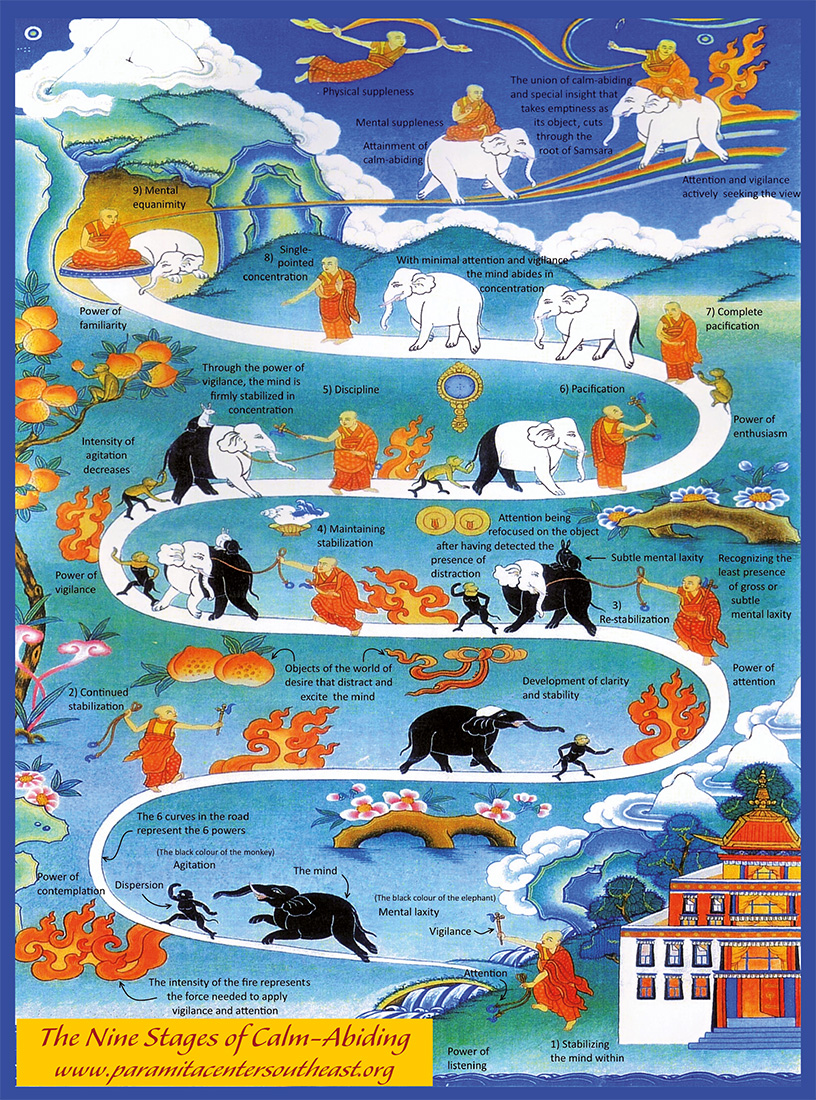
These are deep and profound teachings that monks and lay practitioners alike spend years – perhaps lifetimes – developing. In a weekend, we can’t achieve all the happiness we wish for, but we can explore the path to that true happiness and well-being, and either begin or enhance the journey we are on.
If this sounds like it takes effort, you’re right. Some guided “meditations” and mindfulness “exercises” are simpler, involving simply relaxing and “going with the flow.” These can feel good and can be helpful in limited ways. But learning to meditate takes a willingness to work with our minds to train them. It’s joyous work, but work nevertheless. In this effort, it’s helpful to have a qualified teacher who can help you get started, answer questions, and guide you through the steps of learning.
Why train in this way? We know from research on simple mindfulness meditation that learning to focus mentally reduces stress, lowers blood pressure, improves mood, and increases calm. But there is more. In the Tibetan Buddhist tradition, we also train the mind to focus so that we can become familiar with how our minds work and especially to learn how our minds can help us become happier, more contented, and more compassionate. Ultimately, the main goal is to become familiar with how to be a better person. We train to seek the “mental suppleness” to be able to shape our lives for the better and help others around us.
About the event
This is an opportunity for a 2-day teaching and urban retreat on Calm-Abiding (Shamatha) and Special Insight (Vipassana) meditation in the Tibetan Buddhist tradition of His Holiness the 14th Dalai Lama. Whether new to mediation or to deepen your current practice, come learn with us as we explore ways to establish mental focus and develop a calmer mind capacble of more realistic appraisal of the world and ourselves. The retreat will be led by Les Kertay (Tibetan name Lobsang Tharchiin), sponsored by the Paramita Center Southeast in Chattanooga.
The retreat will be held at Center Space, in St Andrews Center, 1918 Union Avenue, in Chattanooga. There will be 7 sessions of teaching and practice, each about 90 minutes, with breaks between. A lunch break will be from 1:00-2:00. We will provide snacks, coffee/tea, and water. You may bring your lunch and/or a dish to share. There will be meditation cushions and chairs available; however, we recommend bringing a yoga mat or a blanket, as well as your own meditation cushion if you prefer.
Because spots are limited, we will not be able to provide refunds if you cancel after March 10.
About the teacher
Les Kertay (Lobsang Tharchin) became interested in Buddhist philosophy as a teenager, and his interest in Buddhism continued throughout a long career as a psychologist, teacher, and consultant. Though he spent many years studying and taking teachings where he could, he wasn’t able to put the teachings together in a meaningful way despite his best efforts until 2020, when he met and began training intensively with Lama Samten. Lama Samten is a Tibetan Buddhist monk and master teacher who was living in Canada, having been trained, ordained, and deeply educated in the Tibetan tradition of His Holiness the 14th Dalai Lama.
Les has been studying with Lama Samten and the other teachers of the Paramita Centres of Toronto and Québec in this tradition, and in 2024 Lama gave permission to teach and bring the Paramita Center tradition to the US. Les continues to study, teach, and work to spread compassion through classes, developing a permanent cetner for Tibetan Buddhism in Chattanooga, and daily life.